


iChain fulfils several requirements: it is characterized by an architecture compatible with the principles of global scalability. It supports the supply chains of the future also taking into account the strategic objectives of sustainability.
iChain drives the internal digital transformation project or of your supply chain and aims at the business objectives activated by Digital Transformation, introducing a collaboration model based on the targeted sharing of process data.
iChain, the shared services platform enhancing your supply chain visibility and transparency.
Provide more practical and powerful tools
to maximize your Digital Transformation benefits
- simple and intuitive tools which reduce the operational complexity, deals with large data volumes with agile mechanism (e.g. interaction and graphical navigation of collected data)
- support decision making by analyzing historical and forecasted data
Leverage integrated technological solutions (HW + SW + Services)
to achieve your new business goals
- sensory systems (both OTS and prototyped) to capture data being stored into the service platform to offer you new numerical models process and extract more process knowledge
- new data analysis methods and techniques (ML / NN, ...) to get more knowledge and ability to control and promptly react to business events
- performance indicators (KPIs), to be built with specific purpose
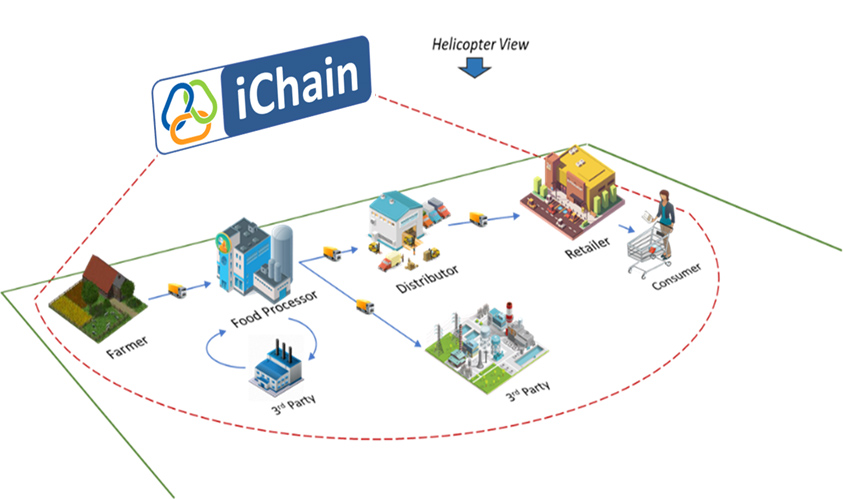
iChain is your service platform. And "i" stands for Intelligent.
iChain, the transparent and collaborative management platform
iChain, understood as an intelligent supply chain service platform, is an advanced system in terms of completeness, robustness, both with respect to the architectural level and to the hardware and software technologies.
The platform instantiates a Cloud / IoT infrastructure for collecting large volumes of data, representing the events that take place along the supply chain that you want to "illuminate". The availability of a large mass of data structured according to models that respect emerging formal and interpretative standards allows iChain to build a real-time image of the supply chain phenomenon to be managed. The complex processing of the collected data (using A.I. and / or Data Analysis techniques) affords a great potential for managing and controlling critical phenomena of interest.
Data collection is carried out thanks to an accurate model allowing data to be shared in a strictly controlled manner by each partner, through the definition of "digital relationships" of visibility (bidirectional, one-to-one) between operators who own the data, and make it available in a controlled way.
Transparency and collaboration require data management models that allow data exchange by interoperation between the existing infrastructures and information systems already active in the various organizations involved.
Therefore, iChain refers to data models compliant with emerging international standards (GS1 EPC / CBV).
iChain - PLUS
iChain in a nutshell:
- It aims to create an innovative model of "supply chain information system" which can be accessed by several companies sharing the same business
- It is a single container of structured data, regardless of the heterogeneity in type, method of acquisition, management, source
- It is a container, a normalizer, a tool for verifying consistency and congruity, an environment for data sharing with other participants of the supply chain in complete safety and according to rules defined in one-to-one relationships on every single data
- "Thinks" about events, and allows you to manage and monitor data at any level of granularity, from a single event to groups of events or processes
- It is based on standards, but can also manage data represented according to proprietary encodings and paths
- It is natively interoperable with other platforms that adopt GS1 EPCIS standards
- It can be adopted gradually by adding functionality and users / companies belonging to the same supply chain over time
- It is developed with the most modern and innovative technologies and constitutes a data collection base for even very sophisticated AI analyses
- It is easily customizable to the specific needs of the company, as processes and events are designed ad hoc
- It allows you to build ad hoc business rules to monitor and highlight any deviations from expected situations
- It has a very advanced user experience and is rich in graphic representations as well as tables, thus facilitating the user in monitoring business processes
- It manages in an integrated way documents associated with events (eg: animal vaccination) or independent from them (eg data relating to suppliers such as DURC, inquiries, ...)
- It allows you to design the process and the events on a process modeler (BPM) integrated into the platform. It has the advantage of allowing users to verify the consistency with the requirements step-by-step.The users will also be able to select the events to be detected / measured, for a faster implementation, allowing continuous and constant checks
iChain functional requirements
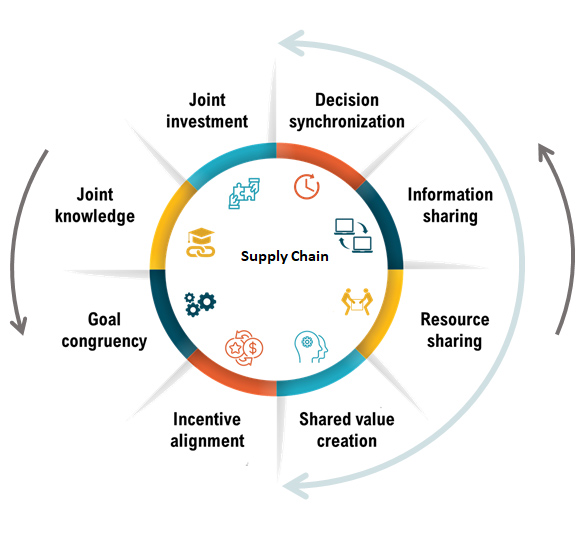
The platforms dedicated to the provision of services in support of the Supply Chain of the future will have to provide the best benefits from modern digital technologies. They will show maximum effectiveness if they succeed in stimulating the desire for collaboration and sharing of information among supply chain partners. This section presents the main characteristics of the Digital Supply Chains of the future.
End-to-end observability
Instant knowledge of the evolution of phenomena occurring throughout the supply chain is a paramount condition to enable quick management reactions. The information systems will have to show flexibility, smooth adoption by supply chain partners and the corresponding ability to deal with a higher volume of shared information.
Interoperability through the use of Global Standards
The current configuration of Supply Chains involves a limited sharing of data, as well as the presence of heterogeneous information systems at each of the participants. The reference to data formats adhering to global standards - together with the maximum protection of confidential information - are essential conditions to implement greater collaboration and circulation of information.
Integration of heterogeneous data
On time supply chain management must also consider conditions and events that occur outside the supply chain itself: in fact, operations can be affected by weather conditions, road problems and many other phenomena. A supply chain management information system must be able to integrate this type of information, either directly or from existing databases and heterogeneous sources.
A single platform to manage internal processes and supply chains
A digital framework for managing an entire supply chain can be seen as the extension of a local system collecting data from the processes of an individual company. In the early adoption stages, a supply chain governance platform can be used by individual partners to introduce transparency and observability of their own production, logistics and other local processes.
Advanced analytics and predictive intelligence
In order to transform the large amount of data collected by the various Supply Chain processes into useful information for end-to-end optimization and quickly reaction in decision making, service delivery platforms must make use of sophisticated algorithms to identify correlations between events, and in the most advanced cases also to forecast the trend of certain phenomena in the short to medium term.
Certified sources and data immutability
Distributed Ledger Technologies are used in order to guarantee the authenticity of the data, and thus ensure third parties about the origin and immutability of the data collected by the system in an inherently untrusted context, along all end-to-end supply chain processes.
Low Code Application Platform (LCAP)
Client organizations often want a fast, agile, low-impact approach to software development (with low coding impact). The data collection functions, their representation in space and time, the automatic graphical representation, the intuitive navigability and the advanced analysis for decisions are integral parts of the platform. This approach reduces deployment times, simplifies human-machine interaction and offers the ability to make rapid decisions/deduction based on observed supply chain data.
Rapid prototyping of organizational process
Business Process Management (BPM) tools are also available for designing processes, applications, work flows, for event monitoring, both at initial setup phases and subsequent phases of users onboard or functions adding.
Document management and relevant multimedia content
In order to make the comprehension of the observed phenomena complete and their analysis self-consistent, it is necessary to have special stores of multimedia data correlated with the observed events and operational processes, at any requested detail level.
iCHAIN ADOPTION JOURNEY
In the most scenarios, the adoption of iChain services goes through the following steps:
- Business targets definition and measurement
- Use cases identification (events, actors, data collection and sharing methods)
- Business process modelling
- iChain install & configuration (cloud & distributed architecture, IoT and external systems)
- Integration with existing data sources
- Data analysis definition
- User training and service starting-up
- Activation of customer support service
An incremental adoption is based on a two-step journey:
- Proof of Concept (PoC), a project limited in time and effective to demonstrate the benefits of adopting the methodology and approach model proposed, normally without incurring significant integration activities with existing information systems;
- Pilot Project, a subset of the overall system strongly integrated with existing systems, to define a complete adoption plan more effectively and to acquire important indications on a change-management strategy for the organizational impacts, in order to maximize the success of the final project.